

Male rhinoplasty that protects your identity.
Men usually ask for a straighter profile and easier breathing without looking operated. That depends on angles, skin thickness and how much of the original dorsum can be preserved rather than rebuilt.
Male rhinoplasty in Brazil follows the same surgical principles as any rhinoplasty, with different aesthetic targets. Men generally keep a straight dorsal line, a lower radix, a nasolabial angle near 90 to 95 degrees and a tip with less rotation and less sharp definition. Thicker, more sebaceous skin and stronger cartilage change the technique, not the goal. Dr. Guilherme Sella, an ENT surgeon in Maringa with a doctorate from HCFMRP-USP and published work on dorsal preservation, plans each case with photographs, digital simulation and nasal ultrasound, always combining breathing function with facial harmony.
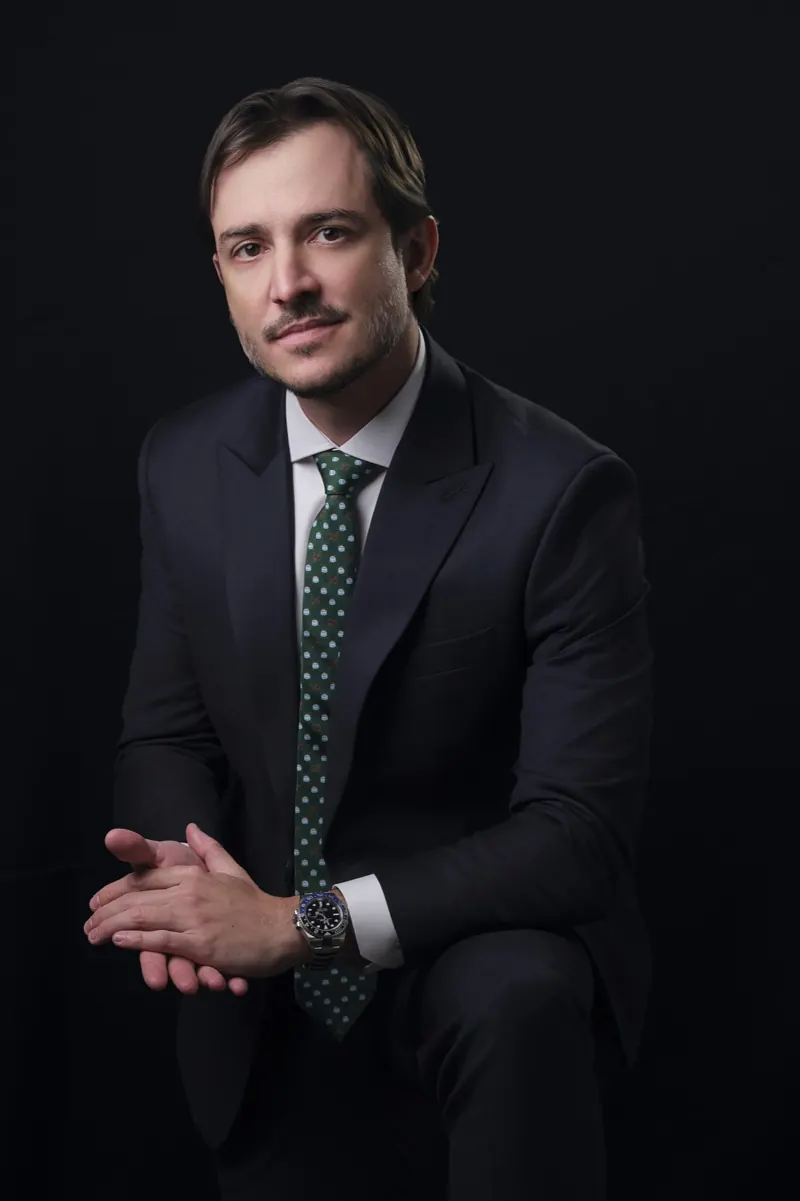
Is male rhinoplasty really different?
The anatomy follows the same rules. The aesthetic reference does not.
In most men, the nose that looks natural is longer in appearance, with a straight or almost straight profile line, a deeper and lower radix at the root, a tip with moderate rotation and a slightly broader, blunter tip definition. Reproducing a feminine profile on a masculine face tends to look operated, even when the surgery was technically clean.
Men also arrive with different anatomy. The skin is usually thicker and more sebaceous, especially over the tip. The cartilage tends to be stronger and less pliable. The bony pyramid is often wider and taller. These factors change how much the nose responds to each maneuver and how long the final result takes to appear.
The starting point of a rhinoplasty consultation is not a nose you saw online. It is your face, your skin and your breathing.
The angles that define a masculine profile
These ranges are references used in facial analysis. They guide planning. They are not targets applied to every patient, because ethnicity, height, facial length and chin position change what looks balanced.
| Reference | Common masculine range | What it influences |
|---|---|---|
| Nasofrontal angle at the radix | Around 115 to 130 degrees, with a lower, deeper root | Strength of the upper third and how the brow meets the nose |
| Dorsal line in profile | Straight, with little or no supratip break | The classic masculine profile; scooped dorsums feminize the face |
| Nasolabial angle | Around 90 to 95 degrees | Tip rotation; excessive rotation exposes nostrils and feminizes |
| Tip definition | Defined, slightly wider, without sharp points | Natural appearance under thick skin |
| Nasal base width | Usually wider, often preserved | Ethnic identity and airflow |
| Chin projection | Must be read together with the nose | A weak chin makes a normal nose look large |
That last line matters. In many male patients, part of the perceived nasal size comes from the lower third of the face. A chin evaluation is part of the facial analysis, and mentoplasty with an implant or bone advancement is discussed when it is relevant to the profile. Any associated procedure is indicated individually.
The dorsum: lowering a hump without destroying the roof
The hump is the most common male complaint. The classic approach removes the bony and cartilaginous hump, which opens the nasal roof and requires reconstruction with osteotomies and grafts. This works, and it is still indicated in many cases. It also changes the original dorsal lines forever.
Dorsal preservation rhinoplasty takes a different route. The surgeon lowers the whole dorsum by working underneath it, with push down or let down maneuvers, keeping the patient's own dorsal aesthetic lines intact. For men, this is often attractive, because the result tends to be a straight profile that still looks like the same nose.
The Dr. Sella has published on exactly this subject. He co-authored "Expanding Indications to Dorsal Preservation Rhinoplasty" in Facial Plastic Surgery Clinics of North America in 2025, "Brazilian Approach to Dorsum Preservation" in 2023 and "Indications for Preservation Rhinoplasty: Avoiding Complications" in 2021. Not every nose is a candidate. Severe deviations, very wide bony bases and some previous surgeries may require structural techniques, or a combination of both.
Thick skin, strong cartilage and what the ultrasound shows
Thick sebaceous skin hides refinement. It also swells longer. In men with this skin type, aggressive tip reduction is a common cause of disappointment, because the skin does not shrink the way the cartilage was reduced.
Two tools help in planning. High frequency dermatologic ultrasound measures skin thickness, detects previous fillers, identifies old grafts or fractures and maps columellar vascularization. Ultrasonic rhinoplasty with a piezoelectric instrument allows bone sculpting with less trauma to soft tissue, which is useful in wide male bony pyramids.
Final results take time. Expect six to twelve months for the nose to settle, and up to eighteen months in thick skin or in revision cases.
Breathing is part of the operation
Many men come for the hump and discover that they have been breathing through one side for years. Deviated septum, enlarged turbinates and weak nasal valves are frequent findings, often related to old sports injuries.
Because Dr. Sella is an ENT surgeon with RQE in otorhinolaryngology, septoplasty, turbinoplasty and valve correction are performed in the same procedure when indicated. The clinic works on a private basis and issues documentation so the patient can request reimbursement from an insurance plan, including the functional part.
Recovery for men: work, gym and beard
- External aquaplast splint for around 7 days, followed by taping for about one more week
- Hospital stay of 12 to 24 hours at Saine Health Complex in Maringa
- Light bleeding is normal in the first 48 to 72 hours; nasal packing is avoided in most cases
- Periorbital bruising can last up to 15 days; head elevated 30 degrees for at least 10 days
- Numbness of the upper lip and front teeth may last up to 3 months
- No glasses or sunglasses resting on the nose for 4 weeks
- Exercise after 15 days, progressively; sun, beach and pool only after 1 month, with SPF 30 for 3 months
- Shaving around the nose is easier with an electric razor in the first weeks; avoid pulling or pressing the tip
- Never blow your nose; use saline irrigation as instructed
Most men with desk jobs return to work once the splint comes off, accepting that mild swelling and some bruising are still visible.
Why men travel to Brazil for rhinoplasty
Brazil has a long surgical tradition in facial plastic surgery and ranks among the countries with the highest volume of aesthetic procedures according to ISAPS surveys. Specialist credentials are regulated by the CFM and the RQE number can be verified on the state medical board website. Costs are generally lower than in the United States and Europe because of fee structures, hospital costs and exchange rates.
For international patients, the usual path is a teleconsultation first, preoperative exams in the home city, arrival one or two days before surgery and about seven days in Maringa until the splint is removed. Flying is released after that. Follow-ups at 1, 3, 6 and 12 months can be in person or online. The team speaks Portuguese, English and Spanish, and issues documentation in English or Spanish on request. Maringa airport receives direct flights from Sao Paulo and Curitiba.
What the consultation includes
About one hour: history, physical examination including the inside of the nose, standardized photographs, digital simulation, explanation of the proposed technique and the postoperative timeline. Nasal ultrasound is performed when indicated. The simulation is a communication tool with roughly 60 to 70 percent similarity to the final result, never a contract.
The surgical quote is given only after the consultation, since it depends on technique, operative time and grafts. It includes the surgical team, hospital, anesthesia and follow-up visits.
When to see Dr. Sella
Consider a consultation if you have a visible hump, a crooked nose after trauma, a tip that looks heavy or droopy, or persistent nasal obstruction. The same applies if you had surgery before and the profile became too scooped or too feminine for your face.
Indication, risks and surgical plan are individual and defined in consultation. You can contact the team in Maringa to schedule in person or by teleconsultation, or read more about Dr. Sella.

Otolaryngologist and facial plastic surgeon · CRM-PR 33.018 · RQE 17.984. PhD from FMRP-USP, founder of the Sella Learning Center. Updated on 2026-10-15.
Frequently asked questions
Will male rhinoplasty make my nose look small or feminine?
That depends entirely on planning. Masculine planning keeps a straight dorsal line, a lower radix and limited tip rotation, avoiding the scooped profile that feminizes a male face. The plan is defined in consultation based on your facial proportions.
Can a hump be removed without changing the whole nose?
In many cases yes, using dorsal preservation techniques that lower the entire dorsum while keeping your original aesthetic lines. Candidacy depends on the shape of the bony pyramid, septal deviation and previous surgeries.
Does thick skin prevent a good result in men?
No, but it changes the technique and the timeline. Thick sebaceous skin hides excessive reduction and swells longer, so the final result can take up to eighteen months to appear.
Can breathing problems be corrected in the same surgery?
Yes. Septoplasty, turbinoplasty and nasal valve correction are commonly performed together with aesthetic rhinoplasty when indicated, since Dr. Sella is an otorhinolaryngologist.
How long do international patients need to stay in Brazil?
Around seven days after surgery, until the external splint is removed, plus one or two days before the procedure. Flying is usually released after the splint comes off.
When can I go back to the gym?
Light exercise is generally allowed after fifteen days, increasing gradually. Contact sports and anything with risk of nasal impact require a longer wait defined by the surgeon.
How soon can I go back to work after male rhinoplasty?
Most patients with desk or remote jobs return in about 7 to 10 days, after the external cast is removed. Tape is usually kept for another week and is easy to cover in meetings. Jobs with physical effort, heavy lifting or risk of impact to the face need a longer pause, which Dr. Sella defines in your postoperative schedule.
Can I shave normally after nose surgery?
You can shave the lower face and neck in the first days, as long as you avoid pressing or pulling on the nose and the cast. Shaving the upper lip and the area right under the nose is usually easier after the cast comes out, around day seven. An electric razor tends to be more comfortable in the first two weeks.
Is there a maximum age for rhinoplasty in men?
There is no fixed upper limit. What matters is general health, clinical evaluation, preoperative tests and anesthetic risk, not the number on your ID. Older patients often have thinner skin and weaker cartilage support, which changes the technique and the grafts used, and this is discussed individually in consultation.
What is the difference between ultrasonic rhinoplasty and the traditional way of treating a male hump?
The traditional approach uses chisels and rasps on the bone, which transmits more impact to the surrounding structures. The piezoelectric instrument cuts bone with ultrasonic vibration and does not cut soft tissue, allowing more precise reshaping of a wide or asymmetric male pyramid. It is one tool among others, and whether it suits your anatomy is decided after examination and imaging.
Book a consultation with Dr. Guilherme Sella
In person in Maringá, Brazil, or by video consultation. English-speaking team.